

Building Talent, Technology, Research and Innovation for India’s Quantum Future
The next technological revolution will not be defined only by faster computers or smarter artificial intelligence. It will also be shaped by our ability to understand and control the fundamental laws of nature.
That revolution is Quantum Technology.
For India, quantum technology represents more than an emerging field of science. It represents an opportunity to build advanced technological capabilities, strengthen research, develop future-ready talent and participate meaningfully in the next generation of the global technology economy.
The journey toward a stronger Quantum India has already begun. But the real opportunity lies in building an ecosystem where people, research, technology, industry and national ambition work together.
India’s Quantum Opportunity
India has built significant capabilities across information technology, digital infrastructure, space, engineering and scientific research. Quantum technologies could become another important layer in this technological journey.
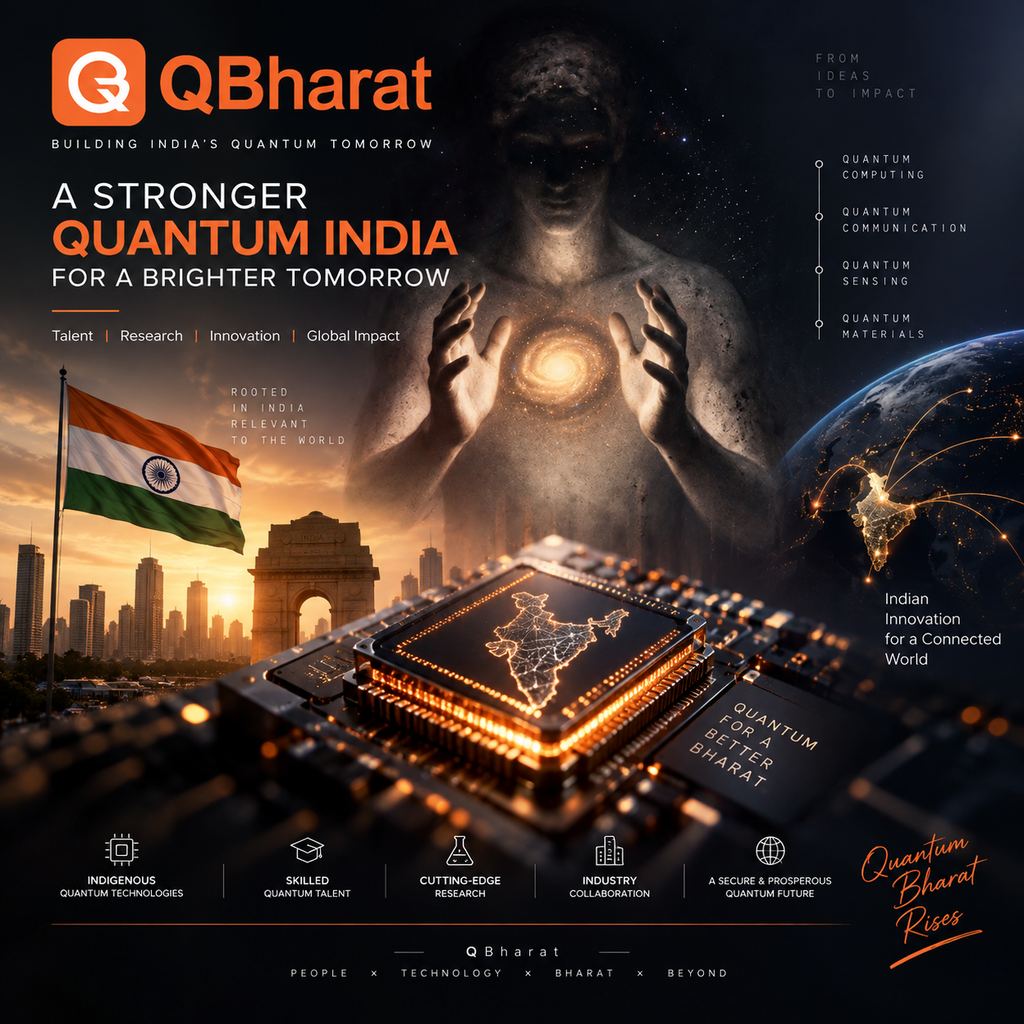
The Government of India’s National Quantum Mission (NQM) has established four major technology verticals: Quantum Computing, Quantum Communication, Quantum Sensing & Metrology, and Quantum Materials & Devices.
These areas are interconnected.
Progress in quantum computing requires better hardware, algorithms, materials and engineering. Secure quantum communication requires advances in photonics, networking and cryptography. Quantum sensing can enable extremely precise measurements, while advances in materials and devices provide the physical foundation required to build many quantum systems.
This means India does not simply need individual quantum projects.
India needs a connected quantum ecosystem.
From Quantum Research to Real-World Impact
A successful quantum ecosystem cannot stop at research papers or laboratory demonstrations.
The larger journey must be:
Research → Discovery → Prototype → Technology → Commercialisation → Deployment → Impact
Universities and research institutions can develop scientific knowledge. Startups can translate discoveries into products. Industry can identify practical applications and provide scale. Investors can support commercialization. Government institutions can create long-term infrastructure and strategic programmes.
When these parts operate together, quantum research has a greater chance of becoming useful technology.
That is where India’s opportunity becomes particularly important: building bridges between laboratories and markets.
Talent Will Be the Foundation
Quantum technology is ultimately a human-capital challenge as much as a technology challenge.
India will need researchers and physicists, but the ecosystem will also require engineers, software developers, electronics specialists, material scientists, cybersecurity professionals, product builders, entrepreneurs, educators and business leaders who understand how quantum technologies can be applied.
Therefore, quantum education cannot remain limited to a small group of specialists.
Students should have opportunities to discover quantum concepts early. Universities need interdisciplinary learning pathways. Researchers need access to advanced infrastructure and collaboration. Professionals need opportunities to become quantum-aware and quantum-ready.
A sustainable ecosystem begins when curiosity becomes education, education becomes skill, and skill becomes innovation.
Building Indigenous Quantum Technologies
Strategic technological capability becomes stronger when a country develops not only applications but also underlying knowledge, intellectual property, components and engineering expertise.
For India, this creates opportunities across quantum processors, control electronics, photonics, cryogenic systems, quantum networking, sensors, algorithms, software platforms, materials and other enabling technologies.
The objective should not be technological isolation. International scientific collaboration remains important.
Instead, the goal should be to ensure that India develops meaningful domestic capability while remaining deeply connected with global research and innovation networks.
Rooted in India. Relevant to the world.
The Four Pillars of a Quantum India
A strong Indian quantum ecosystem can be viewed through four interconnected technological pillars.
Quantum Computing can explore new computational approaches for selected problems in areas such as chemistry, materials, optimisation and scientific simulation.
Quantum Communication focuses on technologies for transmitting and protecting information using quantum principles, including quantum key distribution and future quantum-network research.
Quantum Sensing & Metrology could enable highly precise measurement technologies with potential applications across navigation, scientific instrumentation, healthcare, infrastructure and other domains.
Quantum Materials & Devices provide critical physical foundations from materials and fabrication to photonic and electronic components needed for the broader quantum technology stack.
Progress across these pillars can reinforce the entire ecosystem rather than creating isolated areas of development.
Where Startups and Industry Enter the Story
Quantum technology will eventually need to move beyond academic research into deployable solutions.
This creates an important role for Indian startups and industry.
Startups can experiment with quantum software, hardware, sensing, communication, cybersecurity, simulation and enabling technologies. Established companies can provide manufacturing expertise, infrastructure, enterprise use cases and market access.
Industry participation also creates an important feedback loop: researchers understand real-world problems, while companies gain visibility into emerging scientific capabilities.
The result can be an ecosystem where innovation is driven by both scientific possibility and practical need.
India Should Think Beyond Quantum Computers
Public discussions about quantum technology often focus heavily on quantum computers and quantum chips. They are important, but the quantum opportunity is much larger.
The emerging ecosystem includes hardware, software, communications, sensing, materials, algorithms, cybersecurity, research tools, education, talent platforms, manufacturing, investment and commercialization.
India therefore has an opportunity not merely to build a quantum computer, but to help build an entire quantum value chain.
That distinction matters.
A country that develops talent, intellectual property, research infrastructure, companies, manufacturing capabilities and applications can participate across multiple layers of the emerging quantum economy.
Connecting India’s Quantum Ecosystem
The next challenge is connectivity not only quantum connectivity, but ecosystem connectivity.
A student should be able to discover learning opportunities.
A researcher should be able to find collaborators and funding.
A startup should be able to identify research, talent, investors and enterprise opportunities.
An investor should be able to understand emerging companies and technologies.
Industry should be able to discover relevant quantum use cases.
And policymakers should have access to reliable intelligence about how the ecosystem is developing.
Connecting these participants can accelerate the movement from ideas to impact.
From Ideas to Impact
India’s quantum future will not be built by one organisation, one laboratory, one startup or one government programme.
It will be built through collaboration.
Talent × Research × Innovation × Industry × Infrastructure × Investment
When these forces work together, India can strengthen its ability to create technologies rather than simply consume them.
The objective is larger than technological leadership alone. Quantum technologies could contribute to scientific discovery, strategic capability, new industries, highly skilled employment and solutions to complex problems.
The journey will take years of research, experimentation, investment and institution-building.
But every researcher trained, every student inspired, every prototype developed, every startup created and every collaboration established adds another piece to the ecosystem.
Building India’s Quantum Tomorrow
The quantum era is still developing, which means the future is not predetermined.
India has an opportunity to help shape it.
A stronger Quantum India will be built by investing simultaneously in people, technology, research and collaboration creating an ecosystem capable of transforming scientific ideas into technologies with national and global relevance.
From Ideas to Impact.
From Research to Innovation.
From Bharat to the World.
Quantum Bharat Rises.
— QBharat
Building India’s Quantum Tomorrow