

By QBharat | People • Ideas • Innovation • Bharat
India’s next technology story may not be defined only by artificial intelligence, semiconductors, or space exploration. Quantum technology is emerging as another strategic frontier, with implications for computing, cybersecurity, communications, sensing, advanced materials, healthcare, defence, finance, energy and scientific discovery.
But building a “Quantum Bharat” is not simply about creating a powerful quantum computer.
It requires something much larger: a connected ecosystem where researchers, students, universities, startups, industry, investors and government institutions can move from knowledge → research → technology → commercialization → real-world impact.
That is the idea behind QBharat: People. Ideas. Innovation. Bharat.
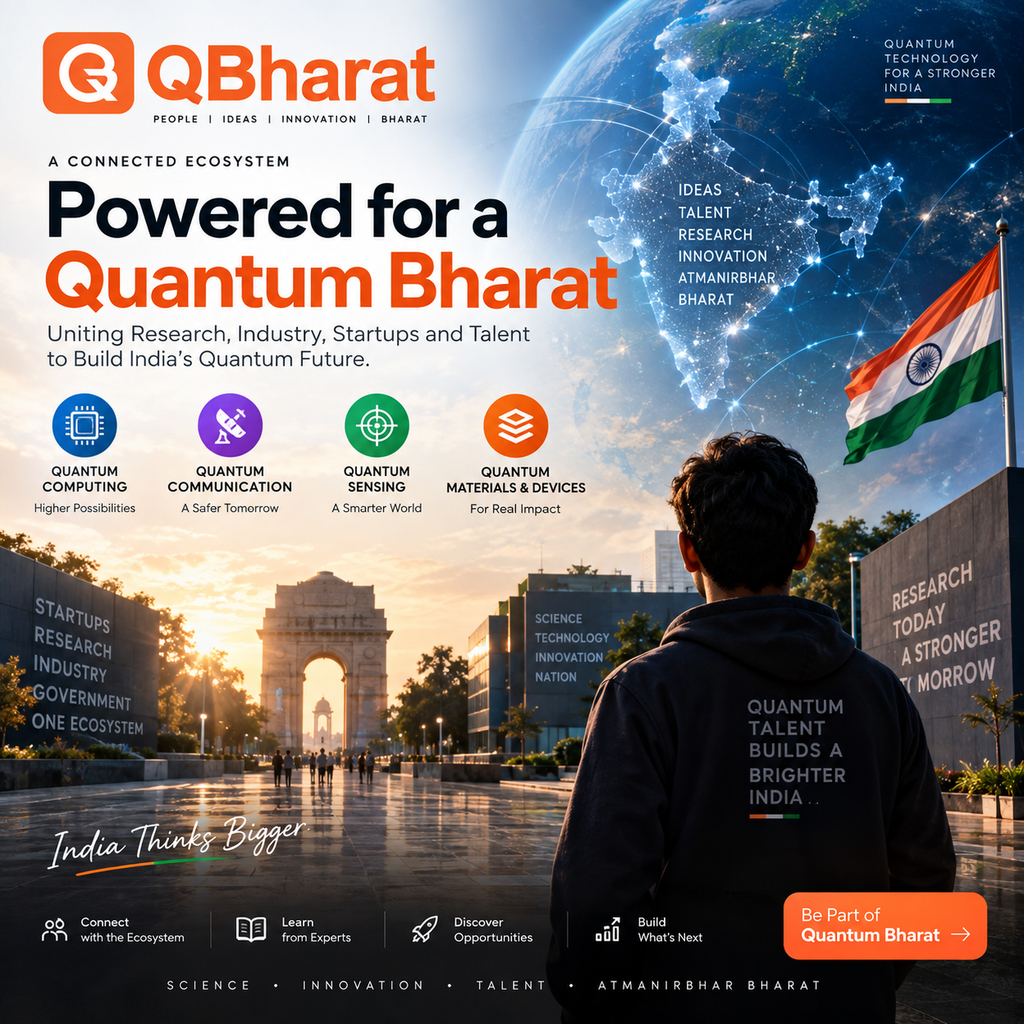
India’s Quantum Journey Has Already Begun
India has established a significant national framework through the National Quantum Mission (NQM). The Union Cabinet approved the mission in April 2023 with an outlay of ₹6,003.65 crore for 2023–24 to 2030–31, with the objective of strengthening scientific and industrial R&D and creating a vibrant quantum technology ecosystem.
Importantly, NQM is not focused on only one technology. India’s national quantum strategy is organized around four major technology verticals:
Quantum Computing • Quantum Communication • Quantum Sensing & Metrology • Quantum Materials & Devices
Four Thematic Hubs have been established to lead these areas: IISc Bengaluru for Quantum Computing; IIT Madras with C-DOT for Quantum Communication; IIT Bombay for Quantum Sensing & Metrology; and IIT Delhi for Quantum Materials & Devices. DST says the wider structure involves 152 researchers across 43 institutions.
This gives India something extremely important: the beginnings of a nationally connected quantum R&D network.
But the next challenge is turning that scientific foundation into an ecosystem that connects research with people, companies, capital, education and deployment.
The Four Pillars of a Quantum Bharat
01 — Quantum Computing: Higher Possibilities
Classical computers represent information using bits. Quantum computers use quantum bits, or qubits, enabling computational approaches based on quantum phenomena.
This does not mean quantum computers will simply replace laptops or conventional supercomputers. Their potential lies primarily in particular classes of problems where quantum approaches could eventually provide meaningful advantages.
Possible long-term applications include molecular and materials simulation, optimization, scientific modelling, cryptography-related research and selected machine-learning problems.
Under NQM, India is targeting intermediate-scale quantum computers containing 50–1,000 physical qubits across platforms including superconducting and photonic technologies.
For India, however, the opportunity goes beyond the number of qubits. It includes building indigenous hardware, software, algorithms, control systems, cryogenic capabilities, quantum-cloud infrastructure and most importantly the people capable of creating them.
02 — Quantum Communication: A Safer Tomorrow
As computing capabilities advance, information security will also have to evolve.
Quantum communication investigates ways of transmitting and protecting information using quantum principles. Technologies such as Quantum Key Distribution (QKD) are particularly important in research around highly secure communications.
India’s NQM includes ambitious communication goals, including satellite-based secure quantum communications between ground stations across 2,000 km within India, inter-city QKD over 2,000 km and multi-node quantum networks with quantum memories.
Such capabilities could eventually matter across government networks, financial infrastructure, defence, telecommunications and other systems handling sensitive information.
This makes quantum communication not merely a scientific project, but part of the broader conversation around India’s future digital sovereignty and security infrastructure.
03 — Quantum Sensing & Metrology: A Smarter World
Some of quantum technology’s earliest practical impacts may come not from computing, but from measurement.
Quantum sensing exploits quantum phenomena to achieve extremely precise measurements of quantities such as magnetic fields, acceleration, gravity, frequency and time.
Potential applications span navigation, healthcare and medical imaging, geological exploration, aerospace, defence, environmental monitoring and scientific instrumentation.
India has therefore established the Quantum Sensing & Metrology Thematic Hub at IIT Bombay as one of the four major NQM hubs.
The broader opportunity is significant: instead of India only purchasing sophisticated scientific instruments from elsewhere, domestic research could increasingly contribute to the intellectual property, engineering and manufacturing behind future sensing systems.
04 — Quantum Materials & Devices: Turning Science into Hardware
Every advanced technology eventually depends on physical components.
Quantum materials and devices therefore form the technological foundation beneath much of the quantum stack from superconducting circuits and photonic components to specialized materials, detectors and other enabling hardware.
DST notes that advances in materials and devices can support computing, communication and sensing simultaneously, making this vertical particularly important to building a sustainable domestic technology base.
For India, this also creates connections between the quantum, semiconductor, electronics, photonics and advanced-manufacturing ecosystems.
And that is where quantum technology can move beyond laboratories into an industrial opportunity.
The Real Challenge: Connecting the Ecosystem
Having excellent laboratories is essential.
But laboratories alone do not create an industry.
A successful quantum ecosystem needs researchers producing knowledge, universities developing talent, startups commercializing technology, corporations becoming customers and partners, investors financing scale, and government creating infrastructure and strategic direction.
India therefore needs strong bridges between:
Research → Talent → Startups → Industry → Capital → Government → Market
This ecosystem philosophy is also visible in the NQM structure itself: DST says the Thematic Hubs are intended not only to advance technology development but also to support human-resource development, entrepreneurship, startups and international collaboration.
That interconnected model is central to what QBharat represents.
From Quantum Research to Quantum Economy
A research paper is valuable.
A laboratory prototype is valuable.
A patent is valuable.
But a functioning innovation economy must also answer the next questions:
Who can use this technology? Who can build a company around it? Who will fund it? Where is the talent? Which university has the expertise? Which industries have real problems quantum technologies might eventually address? And how does an innovation move from laboratory validation to commercial deployment?
This is where India’s next phase becomes particularly interesting.
The goal should not be simply:
“Do more quantum research.”
It should increasingly become:
Research → Translate → Commercialize → Scale → Create Impact
That requires entrepreneurs who understand science, scientists who understand applications, companies willing to experiment, investors capable of evaluating deep technology and students who can see clear pathways into quantum careers.
Talent Will Decide How Far India Goes
Infrastructure can be purchased.
Funding can be allocated.
But an ecosystem ultimately depends on people.
India needs physicists, computer scientists and electrical engineers, but also materials scientists, mathematicians, electronics engineers, photonics specialists, software developers and researchers working across disciplines.
Beyond highly specialized researchers, a mature quantum economy will also need product managers, educators, founders, analysts, policymakers, IP specialists, investors and professionals capable of translating highly technical innovation into viable applications.
DST has explicitly identified human-resource development as part of the mission, including capacity building spanning undergraduate students through doctoral researchers, postdoctoral researchers and skilled technical manpower.
Therefore, India’s quantum ambition cannot remain confined to a small scientific community.
Quantum literacy must gradually move from laboratories into classrooms, startups, companies and boardrooms.
Where QBharat Fits
This is the ecosystem gap that QBharat aims to address.
QBharat is envisioned not merely as another technology website, but as a connected platform for India’s quantum ecosystem bringing together:
People • Ideas • Research • Innovation • Opportunities
Its purpose can be summarized through four actions:
CONNECT — researchers, students, founders, universities, companies, investors and institutions.
LEARN — make quantum knowledge, research developments and expert insights easier to discover and understand.
DISCOVER — surface research, startups, funding, careers, partnerships, events and emerging opportunities.
BUILD — help ideas move toward projects, companies, collaborations and technologies with real-world impact.
In other words, QBharat can become a bridge between people who know, people who build, people who fund and people who need the technology.
Atmanirbhar Bharat in the Quantum Era
Technological self-reliance does not mean isolation.
It means developing sufficient domestic talent, intellectual property, infrastructure, research capabilities and industrial capacity that India can participate in global technology ecosystems from a position of strength.
Quantum technology makes this especially important because capabilities developed today could eventually influence cybersecurity, strategic communications, scientific computing, advanced sensing and future industries.
DST’s own NQM implementation discussions have emphasized developing domestic systems rather than depending entirely on imported technologies, while also recognizing industry’s role in technology and funding partnerships.
So Atmanirbhar Quantum Bharat should not simply mean “Made in India.”
It should increasingly mean:
Researched in India.
Engineered in India.
Protected by Indian IP.
Built by Indian talent.
Commercialized by Indian companies.
Connected with the world.
India Thinks Bigger
India has demonstrated its ability to build large technology ecosystems in areas ranging from digital infrastructure and software to space and pharmaceuticals.
Quantum technology presents a different challenge because much of the science is still evolving and commercialization timelines vary significantly by technology.
That uncertainty is precisely why ecosystem-building matters now.
The countries that establish strong connections among science, talent, capital, industry and policy will be better positioned to convert future breakthroughs into strategic and economic value.
India already has an institutional foundation through the National Quantum Mission.
The next step is making the ecosystem increasingly visible, connected, accessible and actionable.
That means enabling a student to discover a quantum career.
A researcher to find an industry partner.
A startup to find talent and capital.
An investor to understand emerging technologies.
A university to discover collaborators.
An enterprise to identify useful applications.
And an Indian innovation to reach the world.
Powered for a Quantum Bharat 🇮🇳
The quantum future will not be created by a single institution, company, university or laboratory.
It will be created by an ecosystem.
An ecosystem of curious students.
Ambitious researchers.
Deep-tech founders.
Forward-looking universities.
Responsible investors.
Innovative industries.
And institutions willing to build for the long term.
Connect with the Ecosystem.
Learn from Experts.
Discover Opportunities.
Build What’s Next.
Because the goal is bigger than building quantum technology.
The goal is building a Quantum Bharat.
QBharat
People • Ideas • Innovation • Bharat
Science • Innovation • Talent • Atmanirbhar Bharat 🇮🇳